Sunday, October 29, 2017

Constellation Profile - Sculptor

2 comments
We continue our quest through the southern constellations with one that is visible from Calgary.  The constellation is known as 'Sculptor' and it was another of Lacaille's constructions in the 18th century.

In late October, Sculptor can been seen directly from Calgary directly above the southern horizon.  The best way to find it is to locate the fairly bright star in Piscis Austrinus known as Fomalhaut.  Look just to the East of this star and you will be in Sculptor.  The sky map below will help.

Star-hop to Sculptor
Lacaille originally named the constellation Apparatus Sculptoris which was to mean 'The Sculptor's Studio'.  It represents a carved head on a tripod table with a mallet and two chisels next to a block of marble.

Lacaille's original depiction is shown below.

Lacaille's Sculptor
Nearly half a century later, Johann Bode moved a few things around and illustrated the constellation in his Uranographia as shown below.

Uranographia Sculptor
I took the time to create a star map of this constellation.  Although I have yet to locate the Bayer stars in it I thought I would still post the map.

Sculptor
The constellation has quite a few deep sky objects scattered throughout its relatively sparse stellar collection.  The Sculptor Galaxy, also known as the Silver Dollar Galaxy, is a fairly bright object in the northern parts of the constellation.  I am curious to see if anyone from Calgary has observed or photographed it from near our home region.  It has been noted that it is one of the easiest galaxies to observe after the Andromeda Galaxy.  This gives me hope to have an observing attempt if I can find a clear view of the southern horizon.  Since at its highest point it is 15° above the horizon it should be fairly visible from Calgary.

Sculptor Galaxy¹
This evening if the weather is cooperative I may seek out Fomalhaut with my binoculars and cruise over to Sculptor.  I want to say I have spent sometime viewing some of the stars that Lacaille made friends with more than 250 years ago!


¹ (Image Credit - ESO/INAF-VST Acknowledgement: A. Grado/L. Limatola/INAF-Capodimonte Observatory)

Saturday, October 28, 2017

2017 Week 44: (October 29-November 4)

0 comments
We are kicking the first week of November off without much excitement in the sky!  Neptune will once again be in conjunction with the bright waxing gibbous Moon followed by a Full Moon later in the week.

DateEvent
October 30Neptune 0.9°N of Moon
November 3Full Moon

On Halloween night the Moon will be lighting the sky throughout the prime candy collection time.  It rises just after 5pm and will stay in the sky almost until the Sun comes up.  It will be about 90% illuminated so it will help light your way.

Since there are no major events happening in the sky this week we can cover some constellations hanging over our heads.

The three constellations piloted by the Summer Triangle stars are on their way out into the western horizon.  However, you can still catch Lyra, Cygnus and Aquila along with their deep sky objects for another month or so.

Andromeda is in a good location all Autumn as it cruises across the sky just South of zenith.  In dark skies you will be able to see the galaxy as a faint blur of light.  Use the sharp pointy part of Cassiopeia's 'W' to guide you.

Andromeda Galaxy Location
The Great Square of Pegasus will be located on the western edge of Andromeda's chain of stars.  See if you can find the four corner stars forming the square.

If you want to play with the zodiacal constellations you can have a great pick.  Capricornus the goat fish is setting in the southwestern sky in the early evening.  This is followed by my favourite -- Aquarius which is the current home of our farthest planet: Neptune.  Continuing the water theme is Pisces, the pair of fish which houses Uranus at this time.  Pisces is quickly followed by Aries and Taurus.  The bull is back and making its presence known in the eastern sky.

The image below highlights the ecliptic (path of the Sun) corresponding to the zodiacal constellations.

Early November Southern Sky
The sky should hopefully be clear until the predicted Winter storm hits us on November 1.  I am hoping to observe some more constellations and create profiles for them.  Our continuing tour of the southern constellations will likely transpire during the course of the storm.

This evening (October 28, 2017) will be a star night at Ralph Klein Park from 7pm-10pm.  It is free and perfect for families with kids of all ages.  There will be indoor and outdoor activities with hot chocolate!  Hopefully we will see you out there!

We have tentatively booked the McKenzie Lake Community Centre for a community star night from 7pm-9pm on November 10, 2017.  There will be a quick lecture to teach a topic followed by a highlight of what we can see outside through the telescope.  There will be a craft for kids (and adults if you would like!) and hot chocolate to ward off the cool weather.  Following the lecture we will go outside into the school field to look at the discussed objects through the telescope!  Stay tuned on our Facebook Page for more details closer to the time!

Stay warm and keep looking up!

Friday, October 27, 2017

Constellation Profile - Antlia

0 comments
In the previous blog the constellations of Nicolas-Louis de Lacaille were discussed.  This great French astronomer mapped the southern stars and compiled an exhaustive record.  Through his work he devised 14 new constellations that have since become official.

The first one we will discuss in Antlia.  Antlia was originally named Antlia Pneumatica and is a representation of an 18th century air pump present in many scientific labs throughout Europe.  An image of an antique air pump is shown below.

Antlia (Air Pump)
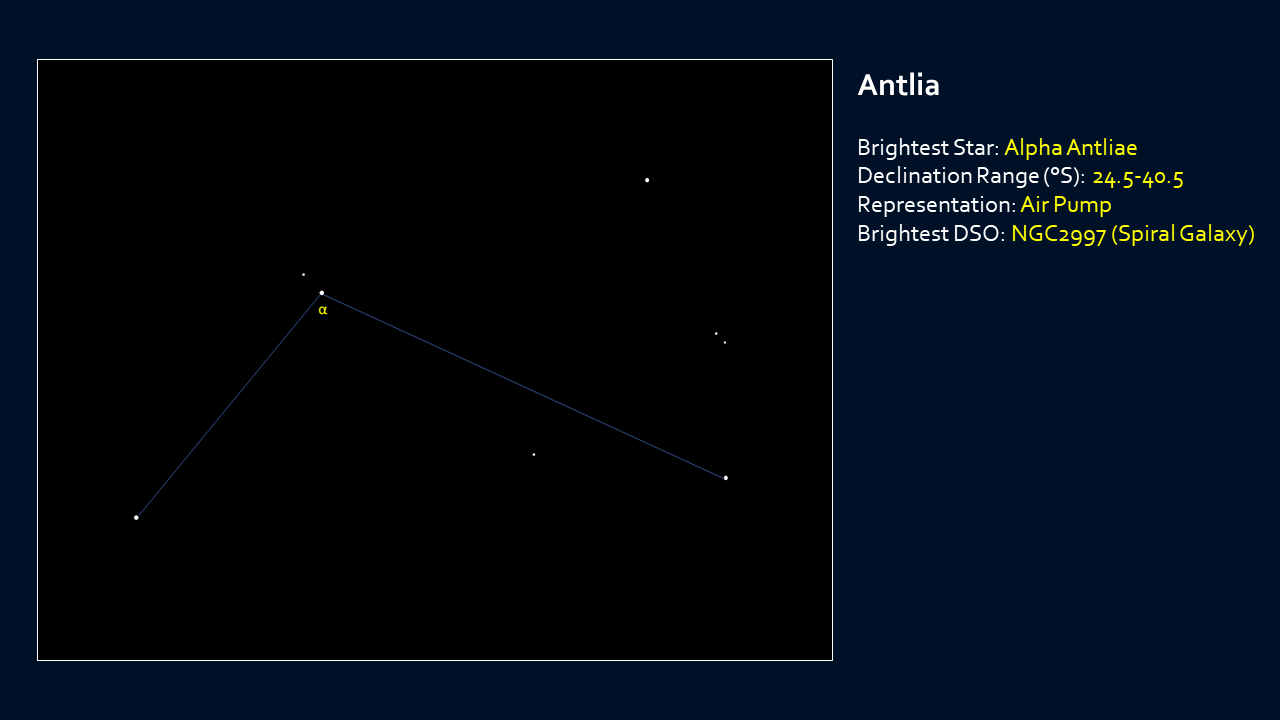
The constellation contains relatively faint stars, much like Cancer in the North.  Most of the constellation is visible from Calgary in the mid-evening (11pm) from mid-March to mid-April.  It may require binoculars to see as it will be low in the southern horizon and its brightest star is only 4.28 magnitude.  I see a star-hopping path to the constellation in the early Spring.  I would start at Alpha Leonis (Regulus) in Leo and hop South to Alpha Hydrae (Alphard) then continue South the same distance but line up under Regulus again.  The map below may help you find it.

Star-hop to Antlia
I have not observed this constellation but have provided a log below consistent with my other observed constellations.

Antlia
A German astronomer by the name of Johann Bode published what is known as the Uranographia.  The Uranographia was a star atlas dedicated to showing the positions of the stars and supplying an artistic representation of the sky.  An image of Antlia from his work is shown below.

Uranographia Antlia
This image is an upgrade from Lacaille's original depiction shown below.

Lacaille's Antlia
There are various galaxies located throughout Antlia, the brightest being NGC 2997 at 10.6 magnitude.  There is even a galaxy cluster known as the Antlia Cluster consisting of a couple hundred galaxies.  It is the third closest galaxy cluster to our own Local Group and, unusually, contains no dominant galaxy.

It has been fun learning about some southern constellations when our own sky is cloudy.  Even if I may never have the opportunity to personally spend time under the southern hemisphere stars I can vicariously travel there with sky atlases and diaries of great astronomers.

Thursday, October 26, 2017

The Lacaille Constellations

0 comments
In the middle of the 18th century a French astronomer by the name of Nicolas-Louis de Lacaille made a famous voyage to the Cape of Good Hope.  His story is quite remarkable and I hope to explore it in a later blog post.  Lecaille cataloged nearly 10,000 southern stars during his two year expedition to the Cape.  He introduced 14 new constellations which, as of 1928, have been officially recognized by the International Astronomical Union.  There are a total of 88 constellations in the sky.  Lacaille's contribution accounts for more than 15% of the total.

Nicolas-Louis de Lacaille¹
Lecaille, ever an enlightenment scientist, named his constellations after objects found within a lab.  One, Mons Mensa, was named after a landmark in South Africa -- Table Mountain.  He also split the large Argo Navis into three separate constellations: Vela, Puppis and Carina.

I live in Calgary and am unable to see a lot of the southern constellations from my home.  The lowest declination on the celestial sphere visible from Calgary is about -39°S.  This leaves 39°S - 90°S permanently below the southern horizon.

Lecaille's dedication to exactitude and completeness has inspired me to write some words about each of 'his' constellations.  We are able to see some of them from Calgary.  The list below shows the names of the constellations and their declination range.

Constellation~Declination Range (°S)Representation
Antlia24.5 - 40.5Air Pump
Caelum27 - 48.5Chisel
Circinus55.5 - 70.5Compass
Fornax24 - 39.5Brazier
Horologium40 - 66Pendulum Clock
Mensa70 - 85Table Mountain
Microscopium27.5 - 45Microscope
Norma42.5 - 60.5Carpenter's Square
Octans74.5 - 90Octant
Pictor43 - 64Easel
Pyxis17.5 - 37Compass Box
Reticulum53 - 67Reticle
Sculptor25 - 39Sculptor
Telescopium45 - 57Telescope

Six of the constellations are either fully or partially visible from Calgary.  According to my night sky software, Horologium's borders barely creep across the southern horizon.  However, to have a good shot at seeing any of this constellation's stars you would have to be in deep Southern Alberta.  In fact, I might hold a competition for anyone observing and logging a star in Horologium from Alberta.

Currently at this time of year (End of October), Sculptor, Microscopium and Fornax are in the evening sky.  We will go through each of these constellations in the coming weeks.  I will start with the ones visible from Calgary so you can attempt to view them in the southern sky with your naked eye!


¹  (Image Credit: Mille Le Jeuneux - Stoyan R. et al. Atlas of the Messier Objects: Highlights of the Deep Sky. -- Cambridge: Cambridge University Press)

Tuesday, October 24, 2017

Letters to the Blogger - Space Age?

0 comments
I would like to publish the first letter we received in response to news posted on our Facebook page.  If you are interested in contributing anything to our blog we would be more than happy to publish it.

Earlier in the month was the 60th anniversary of the launch of the first satellite: Sputnik.  This moment was captured in rural England with the words of one of our readers.

Space Age?
We all remember a time in our lives when we knew where we were when a certain event happened: Princess Diana’s death, 9-11 and the assassination of President Kennedy.

I remember the first space flight of Sputnik.  I was about ten at the time and we recently had electricity and running water installed in the farmhouse.  We were still trying to come to grips with that reality. Dad had the wireless on to hear the farmer’s forecast for the day: sunny and warm.  The news came on shortly after followed by a news flash that the Russians had launched a rocket into space (Sputnik). This was the stuff of the comic and adventure books my brothers read.


Sputnik
I hurried to eat my breakfast to get to the school bus where the matter could be discussed at length with my peers. The bus was abuzz with the news as we all tried to get our heads around what was happening in the world.  Going through the tranquil, rural countryside the whole concept was truly hard to believe.  We had not long learnt the reason Mount Everest had snow and was cold even though it was nearer the sun.  Mechanization was coming to the farms and the future seemed to be coming fast.

In the following few months it was reported a dog was sent into space – now that really upset the “school bus” crowd who decided they should send one of the scientists instead!

It came to me that there was a much greater world out there and it was up to us and future generations to develop.

-Christine Poole, October 2017


Sunday, October 22, 2017

Community Outreach

0 comments
Over the past few years we have had the opportunity to participate in community outreach programs for astronomy.  These are incredibly amazing events as it seems only a handful of people have had the chance to look through a telescope.  Seeing an object through the telescope for the first time is a unique experience that should be shared with as many people as possible.

Fish Creek Star Night
In order to better enjoy your experience at a public astronomy event there are a few guidelines that may help.

  • There is no need to touch the telescope.  Follow the guidance of the operator and just use your eye to peer through the eyepiece.  A lot of people like to grip the eyepiece in their hand.  This is not necessary and can knock the telescope off its intended target.
  • If you bring a white flashlight it is important to keep it directed to the ground.  White light will disrupt dark adapted eyes making it more difficult for others to safely get around.  A great solution would be to bring or make your own red flashlight.
  • A corollary to the above would be to not look at your phone.  You will have a better experience with dark adapted eyes and can see finer details through the telescopes.
  • No flash photography outside.  
  • Ask a lot of questions!  We are here to not only illuminate your eyes but your minds as well.
  • Attend a variety of events throughout the year.  The night sky changes with the seasons and new, incredible sights will be up each month.

There are some guidelines I have learned that will be of some help to those hosting their own telescope.

  • Ensure the safety of the public by bringing your own red flashlight to help people get around.
  • Keep electric cords outside of heavy traffic areas or cover them with a mat.
  • Show the public where the eyepiece is with your red flashlight and teach them how to look through without touching the telescope.
  • Bring a sturdy stool for children to safely look through the eyepiece.
  • Come with a list of targets in mind across the entire visible sky.  Many times we only have holes through the clouds so don't confine your target list to one specific area.
  • Be careful with the laser pointer and don't let anyone untrained use it.
  • Dress as though it is 10° cooler than forecast.

Eclipse 2017
There are many astronomy events around Calgary each month.  You can find out more by checking out our Facebook page and the RASC - Calgary Centre webpage listed below.

http://calgary.rasc.ca/

Many localities throughout the world have astronomy clubs hosting free events.  If you are not from Calgary seek out the nearest astronomy club and learn about their public outreach!

Astronomy for All Ages
As I've mentioned before we are going to start up a monthly local community star night right here in McKenzie Lake.  We have a great facility and the events will be for all ages and will run in all weather conditions.  A telescope will be available to show off some great sights that you can see from suburban Calgary.  If the weather is not suitable there will be indoor activities for both adults and children.

Saturday, October 21, 2017

2017 Week 43: (October 22-28)

0 comments
We are in the last 10 weeks of the year and after a great week we have a less than thrilling one ahead.  It is important to note that the Orionids will still be streaming by in the sky near the peak this weekend.  Last night was cloudy in Calgary but tonight is looking promising.  The Zodiacal Light is also still in season so check that out in the morning twilight if you have dark skies.  The table below highlights some events happening this upcoming week.

DateEvent
October 24Saturn 3°S of Moon
October 26Jupiter in conjunction with Sun
October 27First Quarter

The Moon is just starting its next cycle and will be in conjunction with Saturn on the 24th but you can best see it on the evening of the 23rd.

Saturn
The day has finally arrived for the year.  Jupiter will be in conjunction with the Sun on October 26.  Weeks after this you will start to see our largest planet poking out in the morning sky.  This is good for those astronomers who like to do their work in the early morning.

The Moon will be a waxing crescent until the 27th when it reaches first quarter.

First Quarter
I had the good fortune to be able to teach several groups of Cubs about the sky.  We covered constellations, the Moon, the Solar System and talked a little bit about deep sky objects.

A link to the presentation is provided below:

Cub Scout Presentation

Soon we will be hosting community star nights at the McKenzie Lake Community Centre located at the following address:

16198 McKenzie Lake Way SE
Calgary, Alberta, T2Z 1L7

There will be a short class with unlimited question and answer time followed by looking at the sky in the school field behind the centre.  We will have a telescope setup with specific targets to aim at for the time of season.  We are hoping to run it on a Friday or Saturday evening from 7pm-9pm or earlier as it gets closer to Winter.  It will be open to all ages but we would suggest anyone under 12 be accompanied by an adult.

Stay tuned on this blog and our Facebook page for details.  We are tentatively looking at November 10 for the inaugural event!