Sunday, March 18, 2018

2018 Week 12: (March 18-March 24)

0 comments
Visual astronomy has been very difficult throughout the past few months. There has been a near record amount of snowfall dumped on the city of Calgary.

Hopefully we will have some clear skies next week and we can see some of the following things.

DateEvent
March 18Venus 4°N of Moon
March 20Spring Equinox
March 22Aldebaran 0.9°S of Moon
March 24First Quarter
March 24Star Night at the Park - Glenbow Ranch

I have been disappointed in the weather this Winter and apparently Spring is upon us.  The Spring equinox occurs on Tuesday at 10:15 MDT.  The southern hemisphere will dip into autumn and they can have some cold weather for awhile.  Once the snow clears it is a great time to get out the telescope.  The sky still gets dark relatively early and the weather will continue to get warmer.

The Moon will be in the western sky during twilight and will be particularly close to Venus on March 18.  Also, if you have yet to catch Venus and Mercury dancing in the sunset sky be sure not to miss it.  Mercury is once again moving toward conjunction with the Sun and we'll only be able to naked eye it for about 1 more week.

Mercury and Venus in the Twilight Sky at Sunset
The above image is the sky on Tuesday evening just after 8:30pm.  Mercury and Venus will fit in the same binocular field.  Venus will be almost full at 96% and Mercury a waning crescent at 23% illumination.  The weather is supposed to be mild and it will be a perfect time to go for a walk with the western horizon in view.  You will see Earth, Venus and Mercury.

I went to the ridge last week and had the opportunity to take a picture of this event.

Mercury (top), Venus (middle), Earth (bottom)
Other than having your last shot at seeing Mercury in the evening sky there is a lunar conjunction with Taurus' eye star, Aldebaran.  Several places in the world will actually see the Moon cover the bright red star.

An event that you should not miss is the Star Night in the Park at Glenbow Ranch.  This is a great opportunity to get out and see the sky through many different telescopes.  Details of this event can be found below:

https://www.facebook.com/events/806270429573001/

As the end of the week nears the Moon will be at its first quarter phase.

The weather is supposed to be less snowy this week but that isn't saying too much.  Hopefully the above freezing temperatures can slowly melt our way out of this wet Winter.

Saturday, March 10, 2018

2018 Week 11: (March 11-March 17)

0 comments
This week was originally forecast to have snow but it seems like it will be clear and warm.  This will be a perfect opportunity to see the night sky.

Unfortunately Daylight Savings Time begins this weekend which means it will get dark at later times in the day.  I am already dreading the day in May where we have constant astronomical twilight throughout the Summer.

The chart below highlights what the sky has in store for us this week!

DateEvent
March 11Daylight Savings Time Begins (Set your clock forward)
March 15Mercury at greatest elongation East (18°)
March 17New Moon

Although it does not look too exciting on first glance it will be an important week.  Remember to set your clocks ahead 1 hour before you go to sleep on Saturday March 10.  The morning will be darker but the evenings brighter based on the time on our watches.

The Moon will be new on St. Patrick's Day.  The New Moon gives astronomers access to the sky without light pollution from our lunar neighbour.

The most important item on the calendar is Mercury's greatest elongation East.  This is the best time to see our innermost planet from mid-northern latitudes in the evening in 2018.  You can already see Mercury sitting a few degrees above Venus in the western sky just after sunset.  Look toward the West about 30 minutes after sunset just above the horizon.  You will immediately see a very bright 'starlike' object in the sky.  This is Venus.  Just above Venus you should see a fainter 'starlike' object.  This is Mercury.  As it spends most of its time tucked in next to the Sun it is only visible at certain times throughout the year.  Just with your eyes you'll see Earth, Venus and Mercury all in a row in the same naked eye visual field.

Mercury, March 2017
The weather for the week looks much different than what we have had throughout most of February and March this year.  The daily highs will be above freezing and the overnight lows tend to dip just below 0°C.  As we move to the end of the week there may be some precipitation but certainly no signs of another Winter storm.

Get outside in the warmer weather and take in the sights of the night sky.  Catch the great Winter constellations before they leave us for another year!

Saturday, March 3, 2018

2018 Week 10: (March 4-March 10)

0 comments
We have just received an enormous dump of snow with some estimates around 30cm.  2018 is turning out to be one of the snowiest years on record.  The sky is supposed to clear out for the week and we might be able to catch some sights in the sky.  I'm less optimistic about finding some ground to setup a telescope.  The chart below describes the events happening this week.

DateEvent
March 4Neptune in conjunction with the Sun
March 5Zodiacal light visible in West after twilight for the next two weeks
March 5Mercury 1.4°N of Venus
March 7Jupiter 4°S of Moon
March 9Jupiter stationary
March 9Last Quarter
March 9Falcon 9 Launch (10:33pm-12:33am Launch Window)
March 10Mars 4°S of Moon
March 10Saturn 2°S of Moon

On Sunday Neptune will be in conjunction with the Sun and will start to appear in the morning sky.  It will likely be visible through a telescope in April for keen observers.  Once again the zodiacal light may be visible to those residing in dark sites away from urban light pollution.  For more information about the zodiacal light follow the link below.

http://simonjastronomy.blogspot.com/2017/02/what-is-zodiacal-light.html

Zodiacal Light
There will be several planets lining up with the Moon this week.  The first will be on March 7 when Jupiter will be in the same binocular field as our closest celestial neighbour.  If you look directly south at 5 in the morning on the 7th you will see this fine sight.

Exactly three days later at the same time look toward the southeast.  The Moon will be just North of Mars and Saturn.  Both planets will be at about the same magnitude (brightness) at 0.6.  The Moon will still be quite illuminated at just past last quarter.

Mercury and Venus require some work with the evening twilight.  The Mercury/Venus conjunction on the 5th will be very difficult.  The pair of inner planets will be about 13.5° away from the Sun.  After the Sun sets you can try to scan the horizon with a pair of decent binoculars to try to find them.  Obviously, do not use your binoculars on the Sun as you will likely go blind.  Wait until the Sun is completely behind the horizon before looking.  Later the following week you will have a great chance to see Mercury as it will be a full 18° from the Sun at its best evening visibility for us mid-northern latitude dwellers.

Jupiter will begin its retrograde motion early in the morning on the 9th.  This is nothing too exciting as it just means the planet will slowly transit East through Libra instead of West.  It will resume its prograde motion in the middle of July.  It's difficult to find good information about prograde and retrograde motion online as it seems only astrologers really care about it.

Also, if you are following space launches, another Falcon 9 will be blasting to the sky late on March 9.  Watch this live at the link below.

https://spaceflightnow.com/

As mentioned above the weather will perhaps be sunny throughout most of the week with temperatures hovering just below the freezing mark at their high.  Extending to the longer term it looks like we may have another week of snow.  Get your observing in when you can we might be in for a stumble across the equinox line this year.


Sunday, February 25, 2018

2018 Week 9: (February 25-March 3)

0 comments
We are nearing the end of February and will be a sixth of the way done with 2018.  This year has gone fast.  The weather has been quite poor for astronomy but hopefully we will be in for a good Spring!  There are a few things to catch in the sky this upcoming week as described in the chart below.

DateEvent
February 28Regulus 0.9°S of Moon
March 1Atlas V Launch of GOES-S
March 1Full Moon

During the last hour of the month the bright star in Leo -- Regulus will be in close conjunction with the nearly Full Moon.  A map of this conjunction is shown below.  If you stick the Moon in a less than 1° field of view on your telescope you should be able to see both through your eyepiece.  Leo will be high in the southeast sky by 11:00pm MST.

Regulus/Moon Conjunction
If you would like more information about Leo follow the link below to my previous mapping of the constellation.

http://simonjastronomy.blogspot.com/2017/03/explore-universe-leo.html

The Moon will be Full in the sky the next evening.  During this cycle the Full Moon has moved far enough from perigee and will no longer be supermooning.

During the afternoon of March 1, 2018 the GOES-S weather satellite is due to launch on an Atlas V rocket.  The launch window is between 3:02-5:02pm.  If you have yet to catch a launch this year this one should be fun.

Atlas V
You can catch the launch live from the following webpage.

https://spaceflightnow.com/

There are a few more launches heading up into space this month including a crewed Soyuz heading to the International Space Station on March 21, one day after the Spring equinox.  It is amazing, Spring is almost here.

The weather this week is looking close to seasonal with temperatures straddling the freezing mark.  Hopefully this will give the deck a chance to dry off and allow a decent spot to put the telescope.  Spring is one of my favourite observing seasons as the Sun still goes down early and the weather is not as cold.  The Winter constellations will still be kicking around in the west and we will also be able to see some old favourites rise in the east.  Virgo and Libra will start to come into play around midnight.  This will be great as Jupiter is currently sitting in the scales!  I look forward to having planets in the sky once again.


Sunday, February 18, 2018

2018 Week 8: (February 18-February 24)

0 comments
It looks like it may be another snowy week here in Calgary with seasonal temperatures.  That is not too much of a problem because there isn't really anything exciting happening in the sky.  The chart below highlights this week.

DateEvent
February 21Falcon 9 Launch
February 23First Quarter
February 23Aldebaran 0.2°S of Moon

The Moon will be at first quarter this upcoming Friday.  This is always a good chance to see excellent features on the Moon at a reasonable time in the evening.  Aldebaran in Taurus will be a mere 0.7°S of the Moon.  This conjunction will be good for people in the Eastern Hemisphere, but we will be able to find both objects within the same binocular field as the Sun sets.

First Quarter Moon
I've mentioned before that the First Quarter is my favourite phase of the Moon.  I've managed to take some great pictures of some craters at or near this phase.  Links to these are shown below.

http://simonjastronomy.blogspot.com/2017/05/explore-universe-tycho.html

http://simonjastronomy.blogspot.com/2017/05/explore-universe-clavius.html

http://simonjastronomy.blogspot.com/2017/05/explore-universe-plato.html

http://simonjastronomy.blogspot.com/2017/05/explore-universe-ptolemaeus.html

If you plan on staying in the house most of the week to avoid the weather you can catch the launch of a Falcon 9 rocket.  Although not as exciting as the Falcon Heavy it is still fun to watch.  It is currently planned to launch at 7:17am Calgary time on Wednesday, February 21.  As always, you can catch all space launches at the following webpage:

https://spaceflightnow.com/


Falcon 9 Launch
If the Moon is covered by clouds, just sit back and watch the Falcon 9 takeoff with the Paz satellite from Madrid, Spain.

Stay warm and hope for better skies!

Friday, February 9, 2018

2018 Week 7: (February 11-February 17)

0 comments
We are in the middle of February and the weather is still quite cold.  We had a tremendous amount of snow throughout the week and there is nowhere to put my telescope!  The Moon will be starting a new lunar cycle and Mercury will be in superior conjunction with the Sun.  The chart below highlights the events of this week.

DateEvent
February 11Saturn 2°S of Moon
February 15New Moon
February 15Partial Solar Eclipse
February 17Mercury in superior conjunction

Although Mercury will be in superior conjunction with the Sun on the 17th it will start to appear in the evening sky by the end of February.  Throughout March, Mercury will be very well placed for evening observers in the Northern Hemisphere.  It was at this time last year I could see our smallest planet for several weeks with just my eye.

There will be a partial solar eclipse on the 15th of February.  This is not something to get excited about as it will only be visible in Antarctica and the southern third of South America.  For less than an hour the Moon will barely take a bite out (maximum 8%) of the Sun from Santiago, Chile.

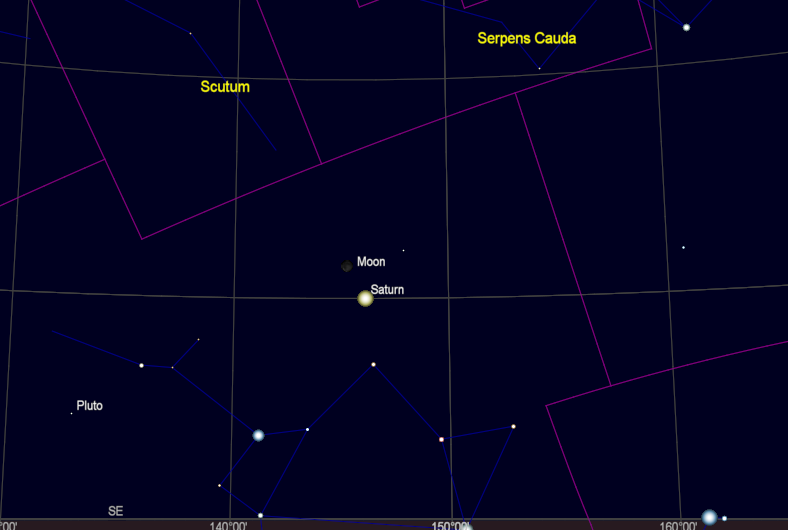
A thin waning crescent Moon will appear very close to Saturn on Sunday morning.  The map below shows the southeastern sky a few minutes after 7am local time.  If you look carefully through binoculars you might see the Moon graze the naked eye star 21 Sgr.  The Moon and Saturn will both be in the same binocular field.  If the weather is good have a look!

Saturn/Moon Conjunction, February 11, 2018
The weather throughout the week is supposed to be close to seasonal.  The weather warms up, then dips, then warms up again.  Hopefully it will be enough to help clear the snow from my observation deck!  There is chance of some more snow but certainly nothing like we had during the previous week.

I would suggest looking for some of the Winter constellations before they are engulfed in the later setting Sun in the Spring.  Orion, Taurus and Gemini are all well worth looking at with the eye and through optical equipment.

I am looking forward to getting through the cold Winter months for some great Spring observing.  I have some new equipment to try out and don't want to freeze.  Also, stay tuned for another McKenzie Lake Star Night where there will be crafts and great observing in the sky!

Thursday, February 1, 2018

2018 Week 6: (February 4-February 10)

0 comments
Week six of the year and the flu is running through the family.  Hopefully everyone will be better by the end of the week.  The Moon is moving away from being full into its last quarter phase which means there will be some planetary conjunctions.  The table below highlights these events.

DateEvent
February 6Falcon Heavy Launch
February 7Last Quarter
February 7Jupiter 4°S of Moon
February 8Mars 4°S of Moon
February 9Vesta 0.9°N of Moon

The weather is anticipated to be very poor until at least the end of the week.  It should clear up and be much better by my birthday!  However, there is something we can watch from any computer.  The Falcon Heavy is scheduled to launch on February 6!  This massive rocket will be the most powerful since the legendary Saturn V that launched people during the Apollo Missions.  It will be twice as powerful as any rocket currently being launched.  My favourite webpage to watch launches is linked below.  The launch window is set between 11:30am - 2:30pm Calgary time.

www.spaceflightnow.com

There are typically several launches per week that you can watch live.  The Falcon Heavy has been delayed since Q3 2015, so excitement is starting to run high.  I will post links on our Facebook Page to remind you to tune into this great event.

Falcon Heavy on Launch Pad
If you would like to watch the static fire check out the video below.


As for the the local sky Jupiter and Mars have moved more than 15° apart and each will be in the same binocular field as the Moon on the 7th and 8th.  The next day the Moon will be very close to the second largest object in the asteroid belt -- Vesta.  This would be a good chance to try to find it in a telescope or binoculars.

It was unfortunate that the weather was cloudy during the total lunar eclipse last week.  We're going to have to wait until the third week of January in 2019 for our next chance from Calgary.  Stay warm and stay tuned for more great astronomy events around Calgary!